
The People’s Emergency Briefing

The People’s Emergency Briefing is a 50-minute film that aims to engage people with climate change and its issues. It is designed to be shown publicly in local communities, so churches are an ideal venue for screenings. Many churches across the UK have shown the film. Could you?
On this page we’ll answer three basic questions about holding a community screening of the People’s Emergency Briefing to help you decide whether you could do this at your church. At the bottom of the page we’ve listed some resources for further reading.
Why show the People’s Emergency Briefing?
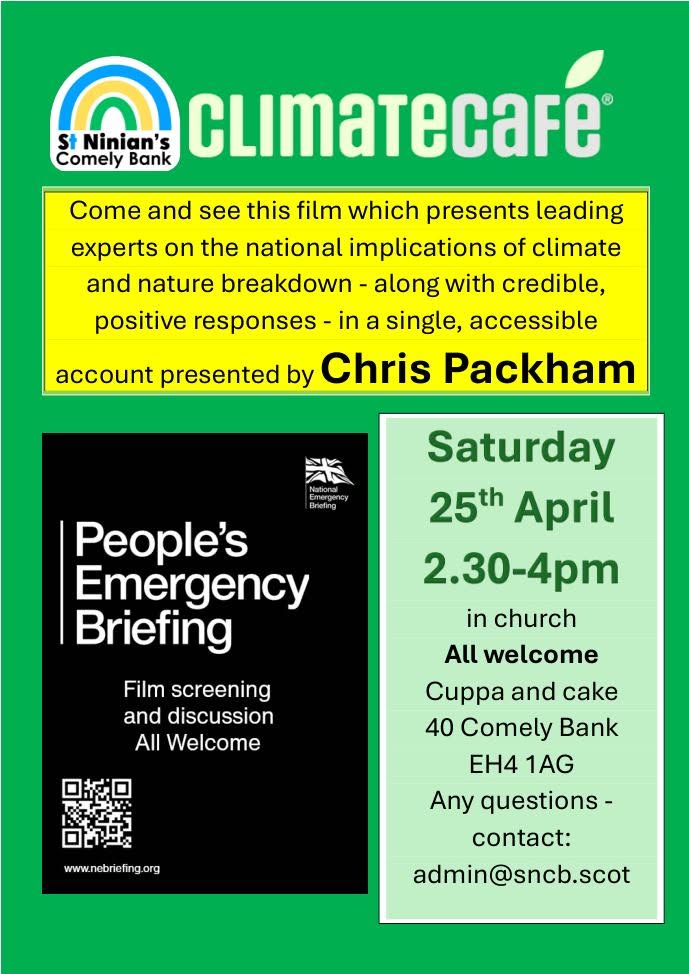
In April, St Ninian’s Church, Comely Bank showed the People’s Emergency Briefing. Alan Baker, Lay Reader at St Ninian’s and also Warden of Lay Readers, says: ‘Climate change has a profound impact on our neighbours whom God calls us to love – our neighbours in this country, our neighbours around the world, and our neighbours in future generations. Those most affected are likely to be the poor, for whom we have a particular duty of care.’
St James, Goldenacre has recently showed the film. Revd Duncan MacLaren, who organised the screening, said before the event: ‘We were aware that many people are privately anxious about the climate emergency, but there often seems to be a taboo about speaking openly about these fears. Bringing people together in one physical space provides support and solidarity and a sense that, though serious, we are not alone in facing these threats. We are hopeful that it may help us to respond to the climate and nature crisis individually, and empower us to put pressure on policy makers to act faster.
‘We decided to show the film before this summer’s extreme heat. But these events have underlined that the crisis is not happening somewhere else. Resource conflicts, mass migration, disease outbreaks, heat-related deaths, wildfires, drought, food insecurity, water scarcity, economic turmoil, political instability and ecosystem collapse are already on our doorstep. A business-as-usual approach to burning fossil fuels will only exacerbate these threats.’
Revd Juliet Stephenson of St Columba’s-by-the-Castle explained the church’s decision to screen the film: ‘We are a thoughtful congregation and our Eco Church group, along with Vestry, have been trying to find ways in which we can engage with Net Zero. We are minded to walk carefully on the planet, and think that engaging with this community screening is a way to help our members and neighbours to re-think the current issues and work together for solutions.’
Our Provincial Net Zero Team is showing the film at its Hope for Creation conference in October. Dr Bethany Nelson of the Net Zero Team says this is ‘to generate discussion within conference guests, but also to equip them to screen the film in their local contexts. The Net Zero Team encourages charges across the province to support community screenings or host their own, following the example of St Andrews, Dunkeld & Dunblane, which is arranging Creationtide screenings in each Area Council.’
What might be the results of a screening?
Practically, the film encourages three actions:
- Writing to local MPs to ask them to support a call to the UK Government to provide a televised climate and nature briefing to the nation
- Signing Chris Packham’s petition for a parliamentary debate and national briefing on the risks from climate and nature breakdown
- Organising more showings of the film itself.
Juliet suggests another result: ‘It’s also a good community engagement event, so we will hopefully make new friends.’ The screening process actively encourages new people through the door: once you have officially arranged a screening, it’s visible on the National Emergency Briefing website, where people can search with a map for their nearest showing. Duncan testifies to the effectiveness of this, saying: ‘We did not advertise our event as it was sold out in four weeks, with most people finding us through the interactive map.’
Making these new contacts is useful: ‘There may be all sorts of connections made between people in our local community that we can’t foresee, but which may begin to build the support we will need to face what is coming as the world heats up,’ says Duncan.
Alan says: ‘It was striking that the showing we had at St Ninian’s attracted a lot of people from outside the church. Many were already interested in the topic of climate change and had a reasonable knowledge about it, but others did not.’
‘We had a local councillor and an MSP candidate among the audience among those to whom specific invitations had been sent. It was greatly appreciated that we had hosted the event. Some people left their contact details so they could be informed about related events at St Ninian’s, notably the Climate Cafe we hold most months.’
How do you go about screening the People’s Emergency Briefing?
‘The process is very easy, as the National Emergency Briefing website has many resources to support organisers,’ Duncan says. ‘Signing up as a venue is very simple, and once on board, you will be sent periodic invitations to watch a live stream of the film accompanied by advice on setting up your showing.’
Juliet says: ‘Contact National Emergency Briefing and fill out the form, they then engage with you and send the links to the film for the date of your showing.
‘You need a stable Wi-Fi, screens and sound, and a place where people can sit comfortably for 50 mins. We are holding a discussion afterwards and a cup of tea!’
About the discussion afterwards, Alan gives this advice: ‘Be sure to ask those there what they feel they could do – are there follow-up events or action groups which the church could help with?
‘Give some time for sharing in small groups or with those sitting beside them, before any wider discussion, so all can feel involved.
‘While raising levels of concern, make sure that there is some leaven of hope in the mix.’
Upcoming screenings in the diocese
St Peter’s, Musselburgh: 21 November at 7pm.
Holy Trinity, Haddington: 11 October at 3pm.
Find screenings on the interactive map.
Resources
National Emergency Briefing website, where you can find resources to support your screening, for example a screening guide and Ten Tips for Hosting a Screening, with advice gleaned from more than 500 showings.
Hosting the People’s Emergency Briefing: A new resource for churches is a page on the Church of England website to support churches in hosting screenings.
National Emergency Briefing: A call to action for churches. A PDF document with ideas and advice for hosting a screening and further resources, including prayers, discussion points and article templates.
Are you holding a screening? If so, the Net Zero Team would love to know, and so would we! Email Bethany Nelson (Net Zero Team) at BethanyN@scotland.anglican.org or diocesan mission and ministry at dmmcadmin@dioceseofedinburgh.org.